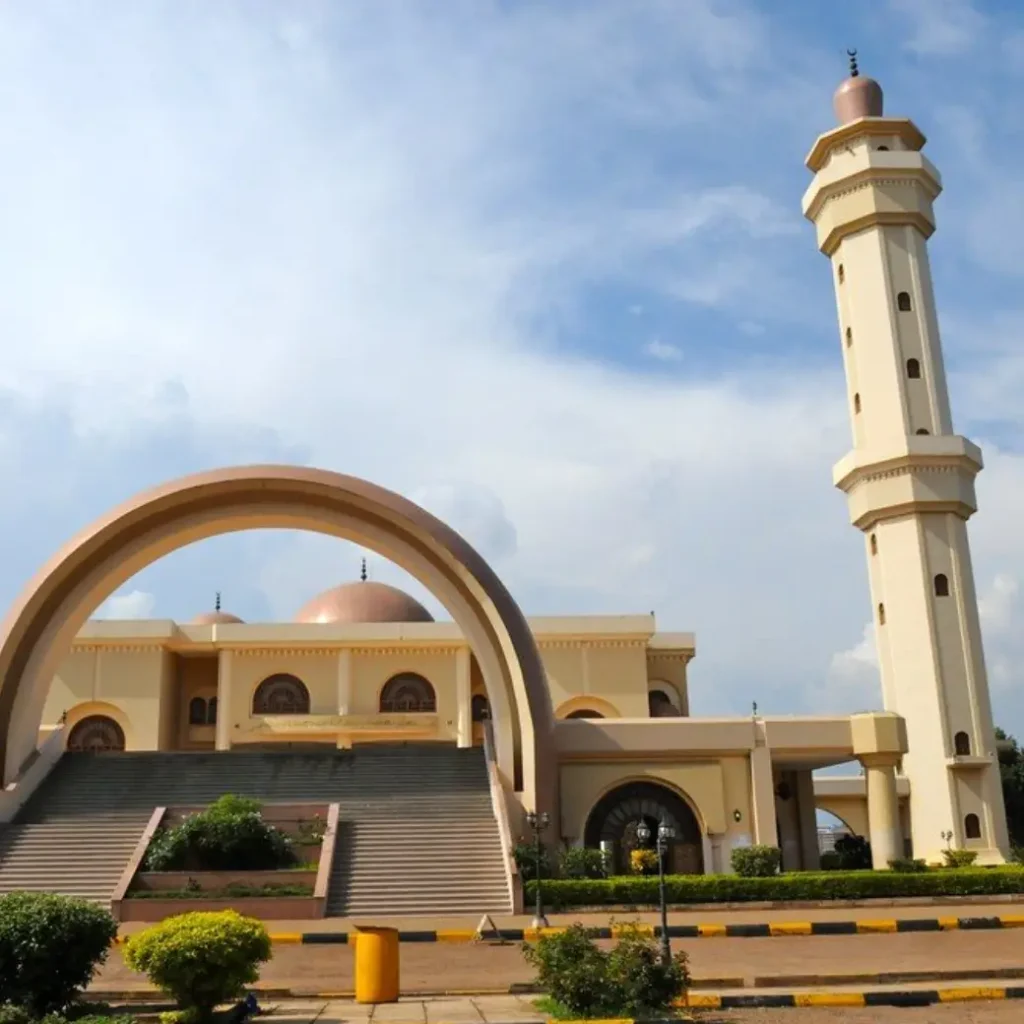
Set on more than 10 acres, the mosque is designed to accommodate 15,000 worshipers in its main prayer hall, with additional space for 1,100 in the upper gallery and 3,500 on the rooftop terrace. The two-story structure houses the mosque itself on the upper floor, while the ground level is home to administrative offices. While the mosque opens primarily for special religious events such as Eid and weddings, the offices remain open throughout the week, keeping the site active and connected to the community.
Just 2.5 kilometers from the city center, the Uganda National Mosque is a highlight for visitors exploring Kampala. It’s often included in guided city tours that go through markets, monuments, museums, and cultural and religious sites. One of the mosque’s standout features is its grand entrance an elegant half-ring design paired with a wide staircase that offers a perfect photo opportunity and a dramatic welcome to the sacred space.
History
Historically, the site of the Uganda National Mosque was once the location of the original fort and capital established by Captain Frederick Lugard in 1890. Decades later, in 1972, President Idi Amin began construction on a mosque at the site, naming it the Old Kampala National Mosque. However, the project was brought to a halt in 1976 amid growing political instability. After Amin was overthrown in 1979, the unfinished mosque was largely abandoned, its future uncertain.
It wasn’t until 2001 that the project was revived, when Libyan leader Muammar Gaddafi offered to fund its completion. The long-abandoned structure, a stark concrete monolith from Amin’s era, was demolished to make way for the grand mosque topped with a gleaming copper dome that stands today. The new mosque was officially opened in June 2007 and named the Gaddafi National Mosque after its funder. It also serves as the headquarters of the Uganda Muslim Supreme Council.
Following Gaddafi’s death in 2011, the mosque was renamed the Uganda National Mosque in 2013. The change was a condition for securing rehabilitation support from the new Libyan government, which was reluctant to fund renovations under the former leader’s name.
The Uganda National Mosque’s Architecture
One of the mosque’s most striking features is its towering minaret, which requires climbing 272 steps to reach the top. From there, visitors are rewarded with breathtaking panoramic views of Kampala, especially at sunrise. While daytime visits do not require a booking, sunrise tours starting at 6:30 a.m. must be arranged in advance.
What to do while at The National Mosque
Mosque architecture and furnishings
The main prayer hall is the centerpiece of the mosque: an expansive, carpeted space that remains unfurnished, allowing the architectural elements to take center stage. What immediately commands attention is the forest of towering columns that rise to support the vast roof and the impressive copper dome overhead
The design is a harmonious fusion of influences, drawing from European, Arab, and African architectural traditions. Italian stained-glass windows line the walls, casting soft, colorful light into the hall, while rich Ugandan timber accents lend a sense of local warmth and craftsmanship. Above, the underside of the dome is adorned with intricate Arabian mosaic work that draws the eye upward, culminating in a striking metal chandelier massive, ornate, and suspended like a crown at the heart of the hall.
Panoramic Views from the Minaret
Inside the mosque stands a 50.5-meter-high minaret, accessible by a winding staircase of 306 steps. As you ascend, the spiral climb leads to a breathtaking 360-degree vantage point, offering an unmatched panoramic view of Kampala and its famous seven hills. This elevated lookout is a highlight for many visitors, providing a unique and memorable perspective of the city’s sprawling landscape.
Learn about the mosque’s history and the Supreme Council
Guided tours are available and offer visitors valuable insights into the mosque’s rich history, the principles and practices of Islam, and the important role of the Uganda Muslim Supreme Council, which is headquartered within the complex.
Visiting hours and Entry Fees
The mosque welcomes visitors daily from 8:30 a.m. to 5:00 p.m., with a pause during Friday prayers. The entry fee for foreign non-residents is approximately $5, which includes a guided tour as well as appropriate attire to ensure modest dress during the visit.
Dress Code
Modest attire is required when visiting the mosque. Women are expected to wear loose-fitting clothing that covers the wrists and ankles, along with a headscarf. Men should wear trousers and shirts with sleeves. Those wearing shorts above the knee may be provided with a traditional kanzu. Appropriate coverings are available at the mosque for visitors who need them.