Mountain gorillas are the largest living primates, yet their presence in the forest is defined more by calm than by force. Despite their size, they are remarkably peaceable animals, especially when compared to other primates. This temperament is one of the reasons gorilla trekking is possible at all.
Their calm nature makes them trackable. It also makes encounters feel less like observation and more like quiet coexistence.
In the bamboo forests of Volcanoes National Park, gorillas often pause mid-feed to look directly at the people watching them. The moment is unforced. Their eyes meet yours, not as a challenge, but with curiosity. Sometimes they retreat into vegetation. Other times they approach, moving past guides and visitors with confidence, occasionally brushing against a ranger as they pass.
They show no fear. They show no urgency.
Gorilla Behavior During Human Encounters
Young gorillas are often the boldest. A juvenile may beat its chest as it walks past visitors, performing a gesture it would never attempt toward an adult silverback. It is not aggression. It is learning.
At times, gorillas break the rules without knowing they exist. They approach closer than recommended. They ignore the invisible boundary humans try to maintain. Guides do their best to manage distance, but the reality is simple. Gorillas decide.
This closeness carries responsibility. Gorillas are vulnerable to human diseases, many of which can be fatal to them. The recommended distance of seven meters exists to protect the animals, not to limit the experience.Gorilla Families in Volcanoes National Park
There are twelve fully habituated gorilla families in Rwanda’s Volcanoes National Park. Each family is social, structured, and stable, usually led by a dominant silverback and sometimes supported by a subordinate male.
A typical group includes:
- One dominant silverback
- Adult females
- Juveniles and infants
Group sizes range widely, from smaller families of five to larger groups exceeding thirty individuals.
These gorillas are vegetarian, with bamboo shoots forming a large part of their diet. They also consume leaves, stems, fruit when available, and occasionally insects such as ants, which provide a valuable protein supplement.
Most of the day is spent on the ground feeding and moving. At night, each gorilla builds its own temporary nest, either on the ground or in low trees.
Management and Daily Permits
Volcanoes National Park is managed by the Rwanda Development Board, which oversees conservation, tourism, and protection of wildlife.
Each gorilla family receives eight trekking permits per day, meaning only 96 visitors are allowed to see gorillas daily in Rwanda. This limit keeps encounters controlled and minimizes pressure on the animals.
Because of this restriction, permits often sell out well in advance. Planning ahead is not optional.
The Gorilla Trekking Experience
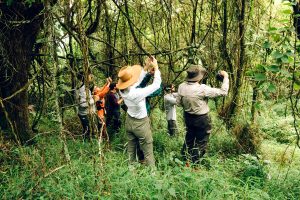
Visitors gather at the park headquarters in Kinigi early in the morning, usually by 7:00 am. Rangers brief groups on safety, behavior, and expectations before assigning each group to a gorilla family based on fitness and trekking conditions.
The families include:
Susa, Amahoro, Kwitonda, Agashya, Muhoza, Umubano, Hirwa, Bwenge, Ugyenda, Karisimbi, Sabinyo, and Igisha.
Trekking time varies greatly. Some families are reached within thirty minutes. Others require several hours of steady hiking through steep, muddy terrain.
No two days are the same.
What to Wear and Carry
The forest sets the terms. Trails are often wet and uneven, even in dry months.
Strong waterproof hiking boots with good ankle support are essential. Walking sticks are provided, and even confident hikers benefit from using them on slippery slopes.
Long trousers and long-sleeved shirts protect against stinging nettles and thorny vegetation. Gloves, especially simple gardening gloves, help when gripping branches or pulling through dense growth.
Clothing will get dirty. Accept this early.
Carry only what you need in a waterproof bag. Drinking water is essential. A rain jacket is useful year-round. Sunscreen, a hat, and sunglasses are helpful when the canopy opens.
Rules That Protect Gorillas
Visitors are allowed one hour with the gorillas. This time passes quickly.
Key rules include:
- Maintain at least seven meters distance
- Do not visit if you are sick
- Do not eat, drink, or smoke near gorillas
- Turn away if you need to cough or sneeze
These rules exist because gorillas share much of our DNA. Illnesses that feel minor to humans can devastate a gorilla family.
Safety and Respect
No tourist has ever been seriously harmed by a habituated gorilla in Rwanda. Still, gorillas are wild animals, vastly stronger than humans, and governed by their own social rules.
Listening to your guide is not optional. It is how the encounter remains calm for everyone involved.
Kwita Izina and Gorilla Conservation
One of the most meaningful times to visit Volcanoes National Park is during Kwita Izina, Rwanda’s annual gorilla naming ceremony. The event celebrates new births and highlights conservation success.
The ceremony brings together park staff, conservationists, communities, and visitors in Musanze. There is music, dance, discussion, and reflection on the future of Rwanda’s gorillas.
It is not a festival for tourists. It is a reminder of responsibility.
Conclusion
Mountain gorillas do not perform for visitors. They tolerate them.
Their calm presence, curiosity, and restraint make gorilla trekking possible, but never guaranteed. Each encounter is shaped by respect, distance, and time.
What stays with most visitors is not the photograph, but the feeling of having been briefly allowed into a world that continues, unchanged, after you leave.