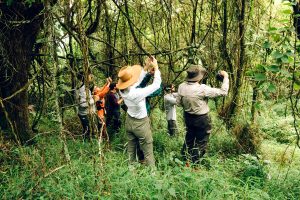
Urban Birding in Kigali
One of Rwanda’s most appealing features for birders is that bird watching can begin almost immediately. Even within Kigali, it is possible to spot a surprising range of species without leaving the city.
Hotel gardens often attract common woodland and garden birds. For a more focused experience, Lake Nyarutarama, located beside the Kigali Golf Course, is an excellent urban birding site. Its walking paths and wetland edges provide opportunities to see:
- Black-headed herons
- Grey-capped warblers
- White-faced whistling ducks
- Spur-winged geese
Another strong urban site is the Nyabarongo Wetland, where birders may spot little egrets, squacco turacos, yellow-billed storks, and spur-winged geese. Nearby Mount Kigali also offers good birding, with species such as red-chested cuckoos, African paradise flycatchers, and southern black flycatchers.
Urban birding in Kigali is ideal for travelers who want meaningful sightings without leaving the city.
Birding in Nyungwe Forest National Park
Nyungwe Forest National Park is the heart of Rwanda’s forest birding. As one of the largest and oldest montane rainforests in Africa, it supports over 300 bird species, including many Albertine Rift endemics.
The Bigugu Trail is one of the best locations for observing canopy-feeding species, while the nearby Gisakura Tea Estate attracts birds that thrive along forest edges.
Some of Nyungwe’s most sought-after species include:
- Red-collared babbler
- Albertine owlet
- Blue-headed sunbird
- Grauer’s swamp warbler
- Handsome francolin
- Regal and purple-breasted sunbirds
- Rwenzori batis
- Rwenzori turaco
- Rwenzori nightjar
- Because the forest is dense and many birds remain high in the canopy, birding here is most productive with an experienced guide and binoculars. Other ways to explore include walking forest trails, cycling sections of the Congo–Nile Trail, or taking the Nyungwe canopy walkway, a nearly 200-meter suspended bridge offering elevated views into the treetops.
The Kamiranzovu Swamp, located within the park, adds another layer of wetland birding to the Nyungwe experience.
Bird Watching in Akagera National Park
Akagera National Park offers a completely different birding environment. Located in eastern Rwanda near the Tanzanian border, the park combines savannah, rolling hills, lakes, wetlands, and papyrus swamps.
Akagera is home to approximately 310 bird species, and birding here can be done both by vehicle and boat.
The best birding areas are around Lake Ihema and its surrounding marshes. A boat safari on the lake is one of the most effective ways to observe water and wetland species.
Notable birds include:
- Red-faced barbet
- Ring-necked francolin (one of the best places in Africa to see it)
- Grey crowned crane
- Northern brown-throated weaver
- African starling, known for its iridescent plumage
Akagera is also one of the few places in Rwanda where patient birders may spot the elusive shoebill stork. In addition to birds, game drives often reveal large mammals such as elephants, lions, leopards, rhinos, buffalo, giraffes, hippos, and numerous antelope species.
Birding in Volcanoes National Park
Although Volcanoes National Park is best known for mountain gorillas, golden monkeys, and volcano hikes, it is also an important birding destination.
The park hosts around 200 bird species, many of which are shared with neighboring Mgahinga Gorilla National Park in Uganda and Virunga National Park in the Congo.
Species found here include:
- Cinnamon bracken warbler
- Grauer’s rush warbler
- Rwenzori batis
- White-tailed blue flycatcher
- Black-and-white mannikin
Birding in Volcanoes National Park is often combined with nature walks or trekking activities, offering opportunities to observe birds along forest edges and bamboo zones.
Lake Kivu and Island Birdlife
Lake Kivu is widely known for its beaches, islands, and fishing culture, but it is also one of Rwanda’s most rewarding birding locations.
The lake attracts:
- White-breasted cormorants
- Pied kingfishers
- Large numbers of migratory water birds during certain seasons
Nkora Island, a small fishing island on the lake, is particularly interesting for water birds and even cave-dwelling bats. Visits here often include interaction with local fishermen, adding a cultural dimension to birding excursions.
Nyabarongo River Wetlands
The Nyabarongo River, a tributary of the Nile, flows through extensive wetlands before joining the Akagera River and eventually Lake Victoria. These wetlands are home to specialized species such as:
- Grauer’s swamp warbler
- Papyrus gonolek
The area is also known for sightings of sitatunga and occasional swamp-dwelling elephants, making it one of Rwanda’s most unique birding landscapes.
What to Pack for Bird Watching in Rwanda
For a comfortable and productive birding experience, it is recommended to carry:
- Binoculars
- A camera with zoom lens
- A bird identification guidebook
- A portable voice recorder (bird calls are an important part of identification)
- Drinking water and snacks
- Insect repellent
Because birding excursions can take several hours and often occur in insect-rich habitats, preparation is essential.
Conclusion
Bird watching in Rwanda is defined by contrast. Within a single journey, travelers can move from city wetlands to ancient forests, open savannahs, volcanic slopes, and vast lakeshores.
The country’s manageable size, strong conservation framework, and habitat diversity make it one of East Africa’s most accessible and rewarding birding destinations. Whether you are a dedicated birder or a curious traveler, Rwanda offers opportunities to observe birds in settings that feel both intimate and expansive.