The Cause of the Martyrs’ Deaths
Kabaka Mwanga II was known for his erratic and vengeful temperament. After ascending to the throne in October 1884, his reign was quickly marred by disasters, including an epidemic that took the lives of several of his wives and chiefs at his first capital at Nabulagala and fires that destroyed his capital at Mengo Hill in both 1886 and 1887. Politically, Mwanga was increasingly threatened to the west by Bunyoro whose leader Kabalega inflicted several defeats on the Buganda army in the 1880s.
Mwanga’s religious stance was largely shaped by practical and political considerations rather than personal conviction. In the early years of his reign, his views were heavily influenced by his Katikiro (chief minister), a staunch Buganda traditionalist who distrusted all foreign religions. However, he regarded Islam as more compatible with Bugandan customs and thus the lesser threat. Mwanga also appeared to view European missionaries as forerunners of imperial domination and their growing influence a threat to his governance. It is perhaps for these reasons that his hostility to Christianity increased and in just three months after taking the throne, he ordered the execution of three young Anglicans
Mwanga’s animosity intensified in 1885 after learning that Bishop James Hannington, an Anglican missionary, was entering Buganda through Busoga a route that local prophecy warned would bring destruction. Fueled by fear and suspicion, Mwanga ordered Hannington’s execution. Shortly after, Joseph Mukasa, a Catholic advisor who openly criticized the king for the killing, was also put to death. These incidents deepened tensions between Mwanga and the Christian missionaries at his court.
The situation reached a breaking point on May 25, 1886. Accounts differ on what provoked Mwanga’s rage some point to the influence of his sister Princess Clara Nalumansi, who publicly turned Christian, married another Christian convert and desecrated several of the kingdom’s customs including burning several fetishes and charms, while others suggest personal rejection by a favored page recently baptized. Regardless of the cause, Mwanga launched a brutal crackdown on Christian converts.
Over the course of ten days, many Christian converts were arrested, tortured, and executed in horrific ways. Some were speared like Gonzaga Gonza, beheaded, castrated, or burned alive. Martyrs that were hacked to pieces include Andrew Kaggwa, Pontian Ngondwe, Matthias Mulumba and Denis Ssebuggwawo. Although 45 victims are recorded by name, the actual number of those killed is likely much higher.
The Massacre at Namugongo
The persecution culminated on June 3, 1886, at Namugongo a traditional execution ground located about 17.5 km northeast of Kampala. In the final week of May, a group of Christian converts was imprisoned near Mengo and forced to march, reportedly naked, to Namugongo. There, they were held for several days as a massive pyre was constructed.
On the morning of June 3, the captives were given one last chance to renounce their faith. At least 26 of them evenly divided between Catholics and Protestants refused. Charles Lwanga, the leader of the Catholic group, was separated, hacked to pieces, and burned alive. The remaining prisoners were bound in reed mats and thrown onto the pyre. Although only 26 are officially remembered, contemporary witnesses suggest that more than 30 people may have perished in the flames.
The tweny-two Roman Catholic martyrs remembered for their faith include, Achilles Kiwanuka, Adolphus Ludigo-Mukasa, Ambrose Kibuuka, Anatoli Kiriggwajjo, Andrew Kagwa, Antanansio Bazzekuketta, Bruno Sserunkuuma, Charles Lwanga, Denis Ssebugwawo, Gonzaga Gonza, Gyavira, James Buuzabalyawo, John Maria Muzeeyi, Joseph Mukasa Balikuddembe, Kizito, Luka Baanabakingu, Matia Mulumba, Mbaga Tuzinde, Mugagga, Mukasa Kiriwawanvu, Noa Mawaggali and Ponsiano Ngondwe.
John Maria Muzeeyi was the last of the 22 martyrs to be killed in 1887. He was beheaded and his body thrown into a swamp.
Many of the Martyrs were pages that is young well behaved boys specially chosen to work in the Kabaka’s palace while others were working in chief’s homesteads.
This tragedy occurred against the backdrop of religious rivalry at the Buganda court, involving the Anglican Church Missionary Society, the French Catholic White Fathers, and Muslim traders. It also took place during the “Scramble for Africa,” when European powers were dividing and colonizing the continent.
Legacy and Canonization
In 1920, Pope Benedict XV declared 13 of the Namugongo martyrs and 9 other Catholic victims from May 1886 as “Blessed,” paving the way for their canonization. On October 18, 1964, Pope Paul VI officially canonized the 22 Catholic martyrs during the Second Vatican Council.
Pope Paul VI later became the first reigning pope to visit sub-Saharan Africa when he made a pilgrimage to Namugongo in July 1969. During his visit, he ordered a shrine and church to be built on the site where Charles Lwanga was martyred.
The Basilica Today
The Church of the Uganda Martyrs at Namugongo was completed in 1975 and later designated a minor basilica. The church is an iconic modernist structure comprising 22 copper pillars over 100 feet long that support the shrine in the form of an African hut. Its wooden doors depict the history of the Martyrs. The Shrine has a capacity of 1000 with seats arranged in circular form. Its altar stands directly over the site where St. Charles Lwanga was burned alive. Beneath the altar made of Italian-designed mahogany is a red-light symbolizing martyrdom, and a glass repository that holds a bone of St. Charles Lwanga, considered a first-class relic.
The Lake & Pavillion (Island)
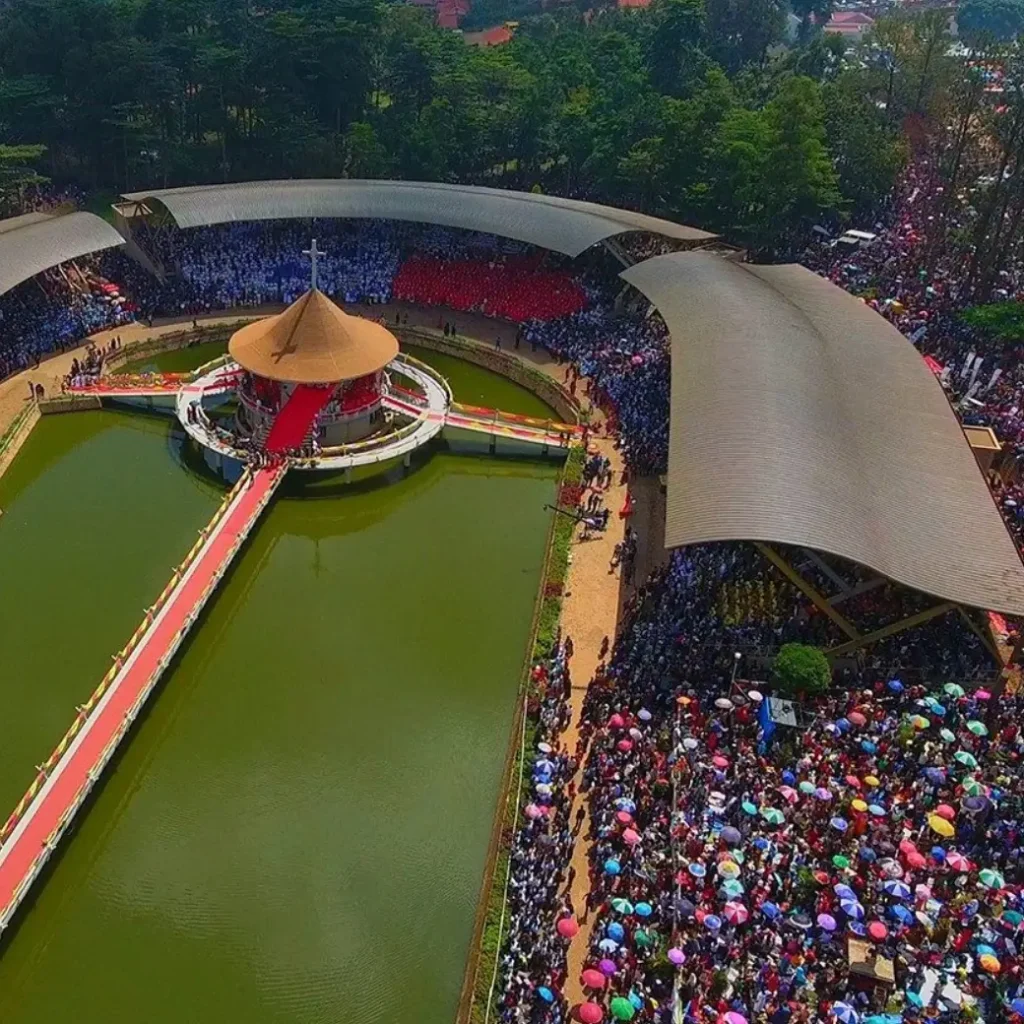
In remembrance of St. Charles Lwanga’s contributions during his time as a page in King Mwanga’s palace most notably his leadership in excavating the famous Kabaka’s Lake at Mengo a symbolic Martyrs’ Lake was created at Namugongo. Pilgrims often draw water from this lake, with many sharing testimonies of its healing power.
At the center of the lake stands a circular pavilion shaped like a shrine, supported by four pillars. This structure can accommodate over 300 priests along with several bishops who participate in the Martyrs’ Day celebrations each year on June 3rd. Tourist on any Uganda Safaris can choose to take on a tour of the shrine where thousands of pilgrims gather around the lake and pavilion, within 15 acres of beautifully landscaped, tree-shaded gardens, to honor the legacy of the Uganda Martyrs in prayer, reflection, and celebration.
Pilgrimage to the Uganda Martyr’s shrine
Today, the shrine is a major pilgrimage site, especially on June 3rd each year, attracting 1 – 2 million pilgrims from around the world who come to commemorate the martyrs’ unwavering faith and sacrifice. The Uganda Episcopal Conference typically chooses a diocese in Uganda to lead the liturgical celebration including readings, music, choirs, dancers and processions, organize pilgrims from across the country and region as well as provide logistical support like hospitality, security coordination and medical services.
Many prominent religious and political leaders have come for Pilgrimage at the Namugongo Martyr’s Shrine including Pope Paul the VI in 1969, Pope John Paul II in 1993 and Pope Francis in 2015 as well as St. Theresa of Culcata in 1988.