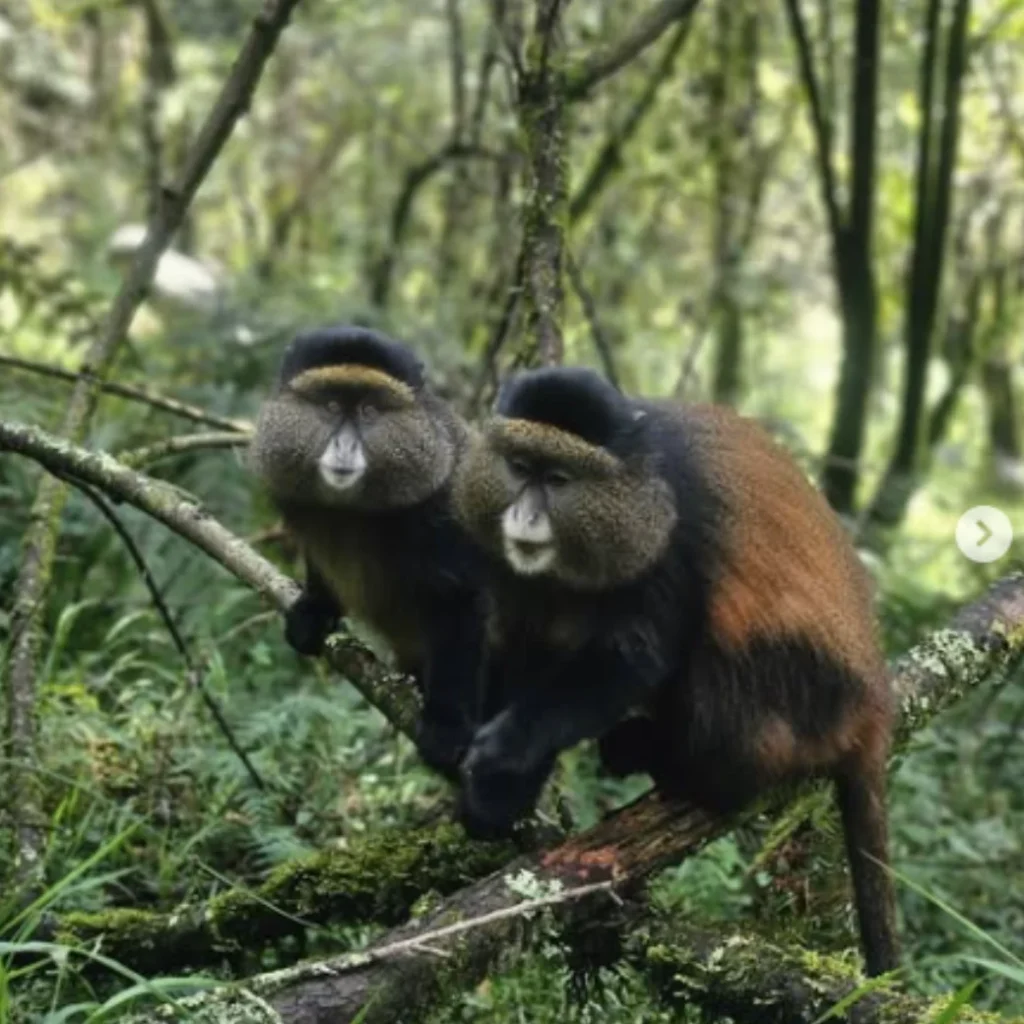
Golden monkeys move quickly through the bamboo forests of the Virunga Mountains, rarely staying still long enough to be studied in detail. Bright fur flashes between branches, calls echo briefly, then the forest settles again. Unlike mountain gorillas, golden monkeys do not dominate their environment through presence. They blend into it through speed and constant motion.
They are endangered, like their larger relatives the mountain gorillas, but far less known.
Golden Monkeys and the Virunga Mountains
Golden monkeys are found only in the Virunga mountain range, a chain of volcanic mountains stretching across Uganda, Rwanda, and the Democratic Republic of Congo. Their global population is estimated at around 5,000 individuals, making them one of Africa’s most restricted primate species.
The Virunga range includes eight major volcanoes:
Mount Gahinga, Mount Sabinyo, Mount Karisimbi, Mount Muhabura, Mount Bisoke, Mount Nyamuragira, Mount Nyiragongo, and Mount Mikeno.
The slopes of these volcanoes support both golden monkeys and mountain gorillas, sharing bamboo zones and montane forest at higher elevations.
Golden monkeys can only be seen and trekked in:
- Volcanoes National Park in Rwanda
- Mgahinga Gorilla National Park in Uganda
- Virunga National Park in DR Congo
Golden Monkey Trekking in Volcanoes National Park
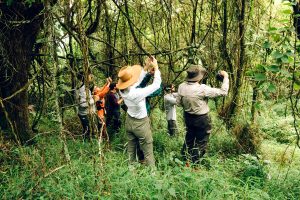
Volcanoes National Park has two habituated golden monkey groups available for trekking. Unlike gorilla trekking, golden monkey tracking is usually shorter, but it is not easier.
Golden monkeys leave little obvious sign of their presence. Trackers rely on subtle clues, including freshly eaten bamboo shoots and distant calls. Once found, the experience becomes fast-paced.
The monkeys leap between branches, forage constantly, and rarely pause. Photography requires quick reactions and fast shutter speeds.
Human presence does not alarm them. Habituation allows visitors to observe them at close range without disruption, though the encounter feels active rather than still.
Permits and Practical Details
Golden monkey trekking permits in Volcanoes National Park cost USD 100 per person.
Permits are issued by the Rwanda Development Board and should be booked in advance, either online or through a reputable tour operator. Availability is limited, and last-minute bookings risk disappointment.
Treks usually last a few hours in total, with one hour spent observing the monkeys once they are located.
Combining Golden Monkeys With Forest Hikes
Golden monkey trekking fits well with other activities in Volcanoes National Park.
One popular hike leads to Dian Fossey’s tomb and the former Karisoke Research Camp. The trail begins near the village of Bisate, about a 30-minute drive from park headquarters. From the trailhead at roughly 2,620 meters, the path climbs steadily through forest.
A resting clearing at around 2,970 meters marks the point where Dian Fossey often paused on her way to camp. From here, the hike continues for another 45 to 60 minutes. Along the way, hikers often spot birds and forest species typical of the Virungas.
Volcano Hikes After Golden Monkey Trekking
For visitors with energy left after the morning trek, more demanding hikes are available.
Mount Bisoke rises to 3,711 meters and is topped by a crater lake. The trail shares its starting point with the Dian Fossey hike and becomes steeper as it climbs. This hike is achievable in a day but physically demanding.
Mount Karisimbi, the highest volcano in the Virunga range, is reserved for dedicated hikers. The two-day climb passes through bamboo, hagenia forest, and Afro-alpine zones dominated by giant senecio and moss. Overnight temperatures can be near freezing, requiring full camping gear and self-sufficiency.
Mount Gahinga and Mount Muhabura are also climbable, offering shorter but still strenuous alternatives.
Cultural Experiences Near Volcanoes National Park
After forest activities, many visitors choose to visit Iby’iwacu Cultural Village, located near the Sabinyo trailhead.
The village is a reconstructed traditional Rwandan homestead set in a wooded clearing. Activities include:
- Traditional Intore dance and drumming
- Community walks
- Demonstrations of millet grinding and banana beer brewing
- Visits with local Batwa community members
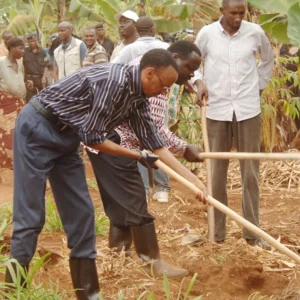
- Agricultural activities such as potato harvesting
The experience provides context rather than spectacle, offering insight into how communities live alongside the park.
Conclusion for golden monkey trekking as written by Peter K Katusiime, the owner of Big Apes Africa
I consider Golden Monkey trekking as the next best thing in all Gorilla highlands be it Volcanoes National Park in Rwanda or Uganda’s Mgahinga National park. This is why; these are the only places where you will see these beautiful rift valley endemics and the secondly the activity does not quite compete with gorilla trekking in terms of financial or fitness requirements. It is very cheap compared to gorilla trekking and as a trek, it is lighter, takes a shorter time, usually 3-4 hours including the time you are with them. This makes it a great add-on just before or after gorilla trekking without a worry that one of the activities will be jeopardized. This opinion is not meant to belittle other expeditions like hiking, birdwatching or nature walks but to give a well balanced view in regard to primates.