The reserve acts as a vital buffer zone for wildlife moving in and out of Queen Elizabeth National Park. It serves as an extension of the park, bordered by Kyambura Gorge to the west, the Kazinga Channel to the north, and Lake George to the south. While it supports similar wildlife to the Kasenyi Plains, Kyambura is not considered a prime game viewing area due to the absence of well-developed safari tracks.
Geography
Kyambura is located on the northeastern edge of Queen Elizabeth National Park, approximately 30 kilometers from the park’s headquarters. The striking Kyambura Gorge stretches for 11 kilometers and connects to the Kazinga Channel. The reserve lies at a mean altitude of 1,100 meters above sea level.
Kyambura Wildlife Reserve is part of the larger Queen Elizabeth Protected Area, which also includes Queen Elizabeth National Park, Maramagambo Forest, and Kigezi Game Reserve—together forming a vast conservation landscape that surrounds Lake Edward. The reserve’s landscape is dominated by savannah grasslands and patches of deciduous thickets, providing an ideal habitat for diverse wildlife.
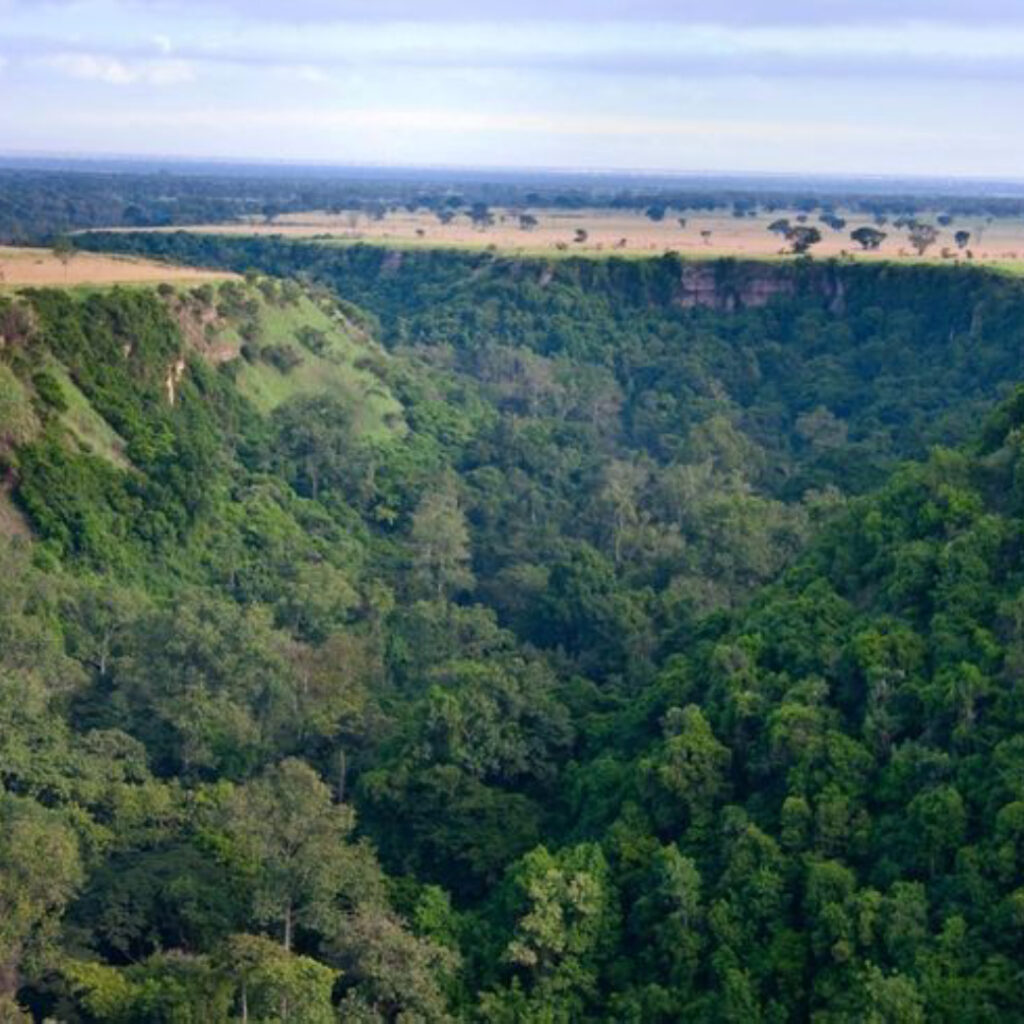
While the surrounding landscape is characterized by gently rolling savannah grasslands, it is dramatically interrupted by the 16-kilometer-long Kyambura Gorge. This deep fissure shelters a lush riverine forest nourished by the Kyambura River, which serves as a crucial water source for the region’s wildlife.
Fauna
The fauna of Kyambura Wildlife Reserve closely resembles that of Queen Elizabeth National Park. The reserve is home to a range of mammals, including hippos, lions, leopards, elephants, buffaloes, and various antelope species along with smaller ungulates. Water birds are especially prominent, with occasional sightings of the lesser flamingo adding to the area’s avian appeal. Access to the reserve is limited to unpaved tracks, which are generally only navigable during dry weather.
What to see and do in Kyambura Wildlife Reserve
Kyambura Game Reserve is a growing ecotourism destination due to its unique landscape and primate population.
Chimpanzee Trekking in Kyambura Gorge
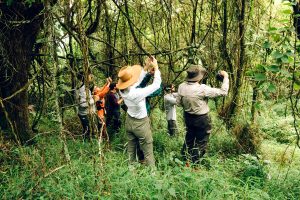
Kyambura Gorge is the only location within Queen Elizabeth National Park where visitors can encounter habituated chimpanzees on treks led by trained Uganda Wildlife Authority (UWA) guides. In addition to chimpanzees, the reserve is home to other primates such as red-tailed monkeys, black-and-white colobus monkeys, baboons, and vervet monkeys.
The chimpanzee population in Kyambura Gorge has become isolated due to deforestation that severed connections to larger forest blocks like Kalinzu and Maramagambo. Conservationists have expressed concerns that this isolation may lead to genetic issues such as inbreeding and mutations.
Chimpanzee tracking in Kyambura offers more than just primate encounters—it also provides breathtaking views of the “underground forest” within the gorge, as well as opportunities to spot birds and smaller wildlife along the way. The activity requires a reasonable level of physical fitness, as it involves trekking over long distances. The minimum age for chimpanzee tracking is 12 years.
Crater Lakes Exploration
One of the main highlights of Kyambura Wildlife Reserve is its chain of seven scenic crater lakes perched above the eastern wall of the Western Rift Valley. Three of these lakes are accessible via a public road that links Kyambura Trading Centre to Kashaka, a fishing village situated at the confluence of the Kazinga Channel and Lake George.
Approximately 10 kilometers from Kyambura village, the rough track to Kashaka runs along the northern edge of Lake Chibwera. This stretch offers visitors a chance to stop and observe wetland bird species such as the little grebe and various ducks. About 3 kilometers further along the route, travelers can enjoy distant views of the aptly named Flamingo Lake, where thousands of greater and lesser flamingos may gather under favorable conditions.
Continuing about 6 kilometers farther, the road passes by Lake Bagusa and a breached crater that connects to Lake George, just before reaching Kashaka fishing village. A small side road branches off along the southern edge of this crater, leading to Lake Maseche—another potential spot for flamingo sightings.
Birding in Kyambura
Visitors to Kyambura Wildlife Reserve can engage in bird watching. The reserve is home to over 300 bird species including the blue headed bee- eater, African Finfoot, and martial eagle. Other species observed in the reserve include the Common Bulbul, Yellow Bishop, Rameron Pigeon, White Stork, Rufous Chested Swallow, Joyful Greenbul, Common Waxbill, Yellow-throated Longclaw, Ross’s Turaco, Black and white Mannikin, Black-winged Stilt, Spur-winged Lapwing, African Sacred Ibis, Western cattle-Egret, Hadada Ibis, Violet backed Starling among others.
Nature Walks & Photography
Nature walks and photography are especially popular along the Kyambura River, where the lush, forested gorge creates a striking contrast against the open savannah landscape, offering a unique setting for scenic exploration and photograpy
- Game Drives
Visitors can easily combine a trip to Queen Elizabeth National Park with an exploration of Kyambura, as both lie within the greater Queen Elizabeth Protected Area. The surrounding grasslands are rich in wildlife, with frequent sightings of elephants, hippos, and various antelope species, making for a well-rounded and immersive safari experience.
- Kyambura View Point
Located about 1.5 kilometers from Kichwamba Trading Centre, just off the western side of the Ishaka Road, the Kyambura Viewpoint sits atop an escarpment with breathtaking views over Queen Elizabeth National Park and the Kazinga Channel. This scenic spot is ideal for a stopover and photo opportunity.
A local community-based tourism association offers guided hikes to the nearby twin crater lakes—Katinda, shaped like a heart, and Milambi, shaped like an egg. The one-hour walk also includes cultural experiences such as visits to a local coffee plantation and a traditional beer brewery.
Entrance fees and Costs in Kyambura Wildlife Reserve
The reserve attracts various fees such as Entrance fees which are $10/$5/$5 for FNR/FR/ROA as well as 2500 Uganda Shillings for East African Residents. Chimp trekking in Kyambura Gorge on the other hand costs $100/$80 for FNR/FR and 50,000 Uganda Shillings for East African Residents.
Best time to visit Kyambura Wildlife Reserve
The Best time to visit the Reserve is during the dry seasons (June – September) and December – February when the trails are more accessible and wildlife easier to spot.
Where to Stay while at Kyambura Wildlife Reserve
- Mazike Valley Lodge: This luxury private lodge located along the eastern escarpment of Queen Elizabeth National Park, adjacent to Kyambura Gorge. It features eight exclusive, beautifully designed cottages that offer both privacy and comfort. Each spacious cottage is equipped with elegant sunken bathtubs, indoor showers, flush toilets, wash basins, and 24-hour hot water. Guests can also enjoy a range of premium amenities, including a cozy and intimate swimming pool, a welcoming guest lounge, private butler service, Wi-Fi, laundry facilities, and sweeping views over the park’s diverse landscapes.
- Buffalo Safari Lodge: Located in Rubirizi near the Kazinga Channel, this lodge offers a comfortable and scenic stay with a range of amenities. Guests can enjoy a swimming pool, an on-site restaurant and bar, spacious rooms with en-suite bathrooms, free Wi-Fi, and breathtaking views of Queen Elizabeth National Park.
- Engiri Game Lodge & Campsite: Located in Katunguru, just 300 meters off the Mbarara–Kasese Road, this budget-friendly lodge sits at the heart of Queen Elizabeth National Park along the scenic shores of the Kazinga Channel. The lodge offers a charming natural setting, featuring traditional-style huts, a campsite, and a main building that houses the reception, lounge, restaurant, and bar.