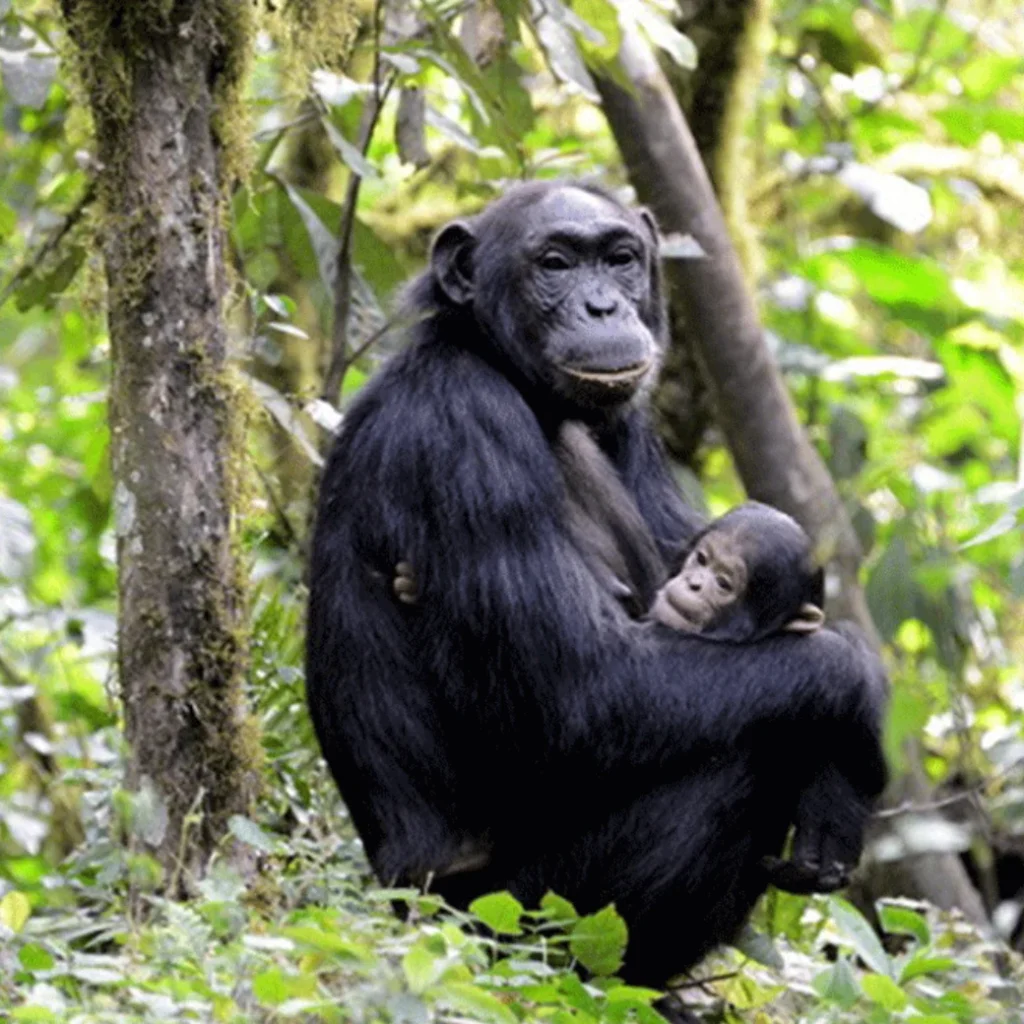
Chimpanzees share 98.7 percent of their DNA with humans, and encounters with them feel intense, unpredictable, and deeply alive. Unlike the calm presence of gorillas, chimpanzees bring movement, sound, and energy to the forest.
Understanding Chimpanzee Social Life
Unlike many primates, chimpanzees do not live in fixed troops. Instead, they form large communities that can number up to 100 individuals, which then break into smaller, constantly changing subgroups.
These subgroups often revolve around close family relationships such as brothers, mothers and daughters, or allied males. Male chimpanzees usually remain in the community where they were born, while females often migrate to neighboring communities after adolescence.
As a result, chimp society is fluid, complex, and highly social.
Leadership and the Alpha Male
Within each community, one alpha male is typically recognized. His role is not absolute dominance, but coordination. He helps maintain order, defend territory, and secure access to resources.
At times, leadership is supported by alliances, often between brothers or long-standing companions. These relationships can be stable for years. However, occasionally rival coalitions form, and leadership is challenged.
These power shifts are rare, but when they happen, they reflect how dynamic chimpanzee societies truly are.
Where Chimpanzee Trekking Happens in Rwanda
In Rwanda, chimpanzee trekking is done exclusively in Nyungwe Forest National Park. There are no other locations in the country where chimps are trekked.
Nyungwe lies in Rwanda’s southwestern region, approximately 5 to 6 hours by road from Kigali. Covering about 1,015 square kilometers, it protects one of Africa’s oldest montane rainforests, believed to have survived since the last ice age.
This ancient forest supports exceptional biodiversity, including species found nowhere else in the world.
Chimpanzee Habituation Explained
Before chimpanzees can be visited by tourists, they undergo a long process known as habituation. During this time, trained researchers and park staff visit wild chimp communities daily.
Initially, chimps respond by fleeing or displaying aggression. Over months and years, they slowly learn that the humans following them pose no threat. Eventually, they tolerate human presence at close range.
Even then, chimpanzees recognize familiar individuals. This is why all chimpanzee trekking is led by park rangers and guides known to the chimps, ensuring both safety and continuity.
Habituated Chimpanzee Communities in Nyungwe
Nyungwe National Park has three habituated chimpanzee communities, each offering a different trekking experience.
Cyamudongo Chimpanzee Group
This community lives in Cyamudongo Forest, a smaller forest patch east of the main Nyungwe block. Although physically separated today, it was once part of the larger forest.
With about 30 individuals, this group offers the highest success rate for sightings, simply because the forest area is smaller and easier to cover.
Uwinka Chimpanzee Group
The Uwinka community lives in the main Nyungwe Forest near the park headquarters. It is larger, with around 60 chimpanzees, but sightings can be more challenging due to the vast terrain.
While numbers are higher, the forest here is denser and movement more unpredictable.
Gisovu Chimpanzee Group
Located in the northern part of the park near Gisovu and Kibuye, this is the newest habituated group. Because they are still adjusting, they may move away quickly when approached.
Over time, this group will become more settled, but for now, sightings can be brief and fast-moving.
What to Wear and Carry for Chimpanzee Trekking
Because Nyungwe is dense and often wet, preparation matters.
Recommended items include:
- Hiking shoes or sneakers with good traction
- Long trousers and long-sleeved shirts
- Rain jacket
- Sunscreen and insect repellent
- At least one liter of drinking water
- Light snacks
Trekking times vary, and patience is essential.
The Chimpanzee Trekking Experience
Chimpanzees build new nests every night, unlike gorillas who may stay in one area for longer periods. As a result, the time needed to find them is unpredictable.
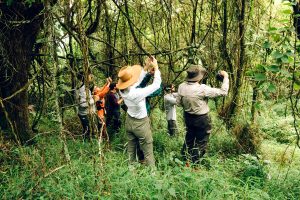
Park trackers go ahead early in the morning to locate the chimps before or shortly after they leave their nests. They then communicate the location to guides, who plan the best route for visitors.
On average, it takes 2 to 3 hours to locate a chimpanzee community.
Once found, visitors are allowed one hour with the chimps.
How Chimpanzee Trekking Differs From Gorilla Trekking
Chimpanzee trekking is energetic and fast-paced. Chimps move quickly, run along the forest floor, and swing high through the canopy. Sightings can be dynamic and sometimes rushed.
In contrast, gorilla trekking is slower and more stationary.
This difference is part of the appeal. Chimpanzee trekking feels raw, noisy, and alive, offering a powerful glimpse into complex primate behavior.
Conclusion
Chimpanzee trekking in Nyungwe Forest is not about quiet observation. It is about movement, sound, and social interaction unfolding in real time.
The forest feels charged when chimps are near. Calls echo. Branches shake. Groups appear and vanish quickly.
For travelers seeking a deeper understanding of primate behavior and a more active rainforest experience, Nyungwe offers something rare. A living, shifting encounter with humanity’s closest relative.